
How Teaching at Oxford Shaped and Could Have Shaped the Future of Biology in the Early 20th-Century
Ștefan Bernhardt-Radu (University of Leeds)
30 November | 16:00-17:30 | Seminar Room 00.063, Schwarzman Centre for the Humanities
We think that the 1953 discovery of DNA and the study of life in the context of DNA was a breakthrough for the life sciences. But there are 21st-century biological and philosophical calls for an equally important ‘holistic’ or ‘organismal’ view of analysing parts in the context of the living whole. The historian Erik Peterson argues that the influence of Cambridge biologists in the 1930s paved the path to this ‘New Biology’, but was overshadowed after 1953. A historical case is thus made to justify the 21st-century re-emergence of the ‘organismal’ view. But I contend that different historical cases are productive for what versions and accounts of the ‘organismal’ view we recover from the past. We can do worse than to look at early 20th-century Oxford. The Oxford embryologist J.W. Jenkinson (1871-1915) saw the organismal view favourably but sceptically. He was a pivotal figure who shaped how the Oxford-educated Julian S. Huxley (1887-1975), one of the most influential 20th-century zoologists, received the organismal view. I show that the education that Huxley got from Oxford formed his understanding of how to study the parts and the whole, which might have been more successful had the First World War never occurred. Through Huxley and Oxford, I argue that we can analyse the contingencies of the realised and unrealised possibilities of the Oxford kind of ‘organismal’ view. With accounts attentive to historical change, we can make better distinctions between the different kinds of organismal views that we may adopt today.
Ștefan Bernhardt-Radu has recently gained his PhD in the History and Philosophy of Science at the University of Leeds. He is interested in the history of biology, evolution, and genetics; in the philosophy of biology; and in the philosophy of history. His PhD explored the biological thinking of the British zoologist Julian S. Huxley (1887-1975) in the context of early 20th-century Oxford biology and philosophy, alongside his evolutionary and social views. He is currently working on a manuscript that explores the relevance of 20th-century Oxford to our historical understanding of 21st-century debates on organisms and evolution.
Download the complete list of seminars
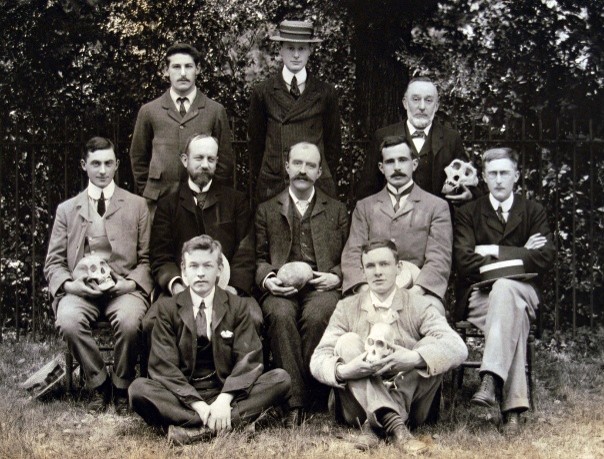
Oxford Biologists in 1901, including embryologist J.W. Jenkinson (mid-row, second from right). Courtesy of the Department of Biology, University of Oxford