
Towards an Operational, Experimental Paradigm in Psychotherapy: Saul Rosenzweig, Worcester State Hospital, and the Tense Origins of the “Common Factors” Idea, 1920s-1940s
Catriel Fierro (Universitat Autònoma de Barcelona)
9 November | 16:00-17:30 | Seminar Room 00.063, Schwarzman Centre for the Humanities
One of the most enduring (and most misconstrued) hypotheses in psychotherapy over the past century is the existence and causal efficacy of “common factors” shared across therapeutic approaches. Known as the “Dodo Verdict” after the equanimous bird in Lewis Carroll’s Alice’s Adventures in Wonderland, the idea was first advanced in print in 1936 by Saul Rosenzweig, a 29-year-old Harvard PhD in clinical psychology during his second year as a psychologist at Worcester State Hospital in Massachusetts. Although later regarded as a major explanation of why psychotherapy works, the hypothesis attracted little attention at the time and was only widely appropriated by psychotherapy researchers from the 1980s onward, often in divergent and inconsistent forms. Considering such inconsistency, this talk reconstructs the institutional origins, theoretical substance, and meta-scientific foundations of Rosenzweig’s original claim. Drawing on archival sources and recent interpretations of operationism as an “epistemology of exploration” (Chang, 2017, 2021; Feest, 2005, 2025; Verhaegh, 2020), I argue that Rosenzweig’s Harvard training exposed him to competing and mutually exclusive traditions, namely Skinnerian behaviorism, psychophysical structuralism, dynamic clinical psychology, and proto-operationism, leading him to acknowledge the need to clarify, operationalize, and experimentally ground hypothetical constructs. These concerns became especially pressing at Worcester, an institution marked by diagnostic uncertainty, therapeutic nihilism, and psychiatrists committed to biological and physiological approaches who reacted promptly and adversely to Rosenzweig’s conjectures. In this setting, Rosenzweig’s “common factors” hypothesis can be construed as an early attempt to operationalize psychotherapy, establish an experimental paradigm for its empirical study, and defend psychological research within a professionally disadvantageous institutional environment.
Catriel Fierro is an Argentinian historian of the human sciences whose work focuses on the overlap between professionalization processes and epistemological issues in the history of American clinical psychology. His current focus is the reconstruction of psychotherapy research during the interwar period from an integrated HPS perspective. A Fulbright alumnus, his work has been featured in Isis, History of the Human Sciences, and History of Psychiatry, among others, and has received the History of Science Society’s 2021 John C. Burnham Award. He is currently a Beatriu de Pinós Postdoctoral Research Fellow at the History of Science Institute of the Autonomous University of Barcelona.
Download the complete list of seminars
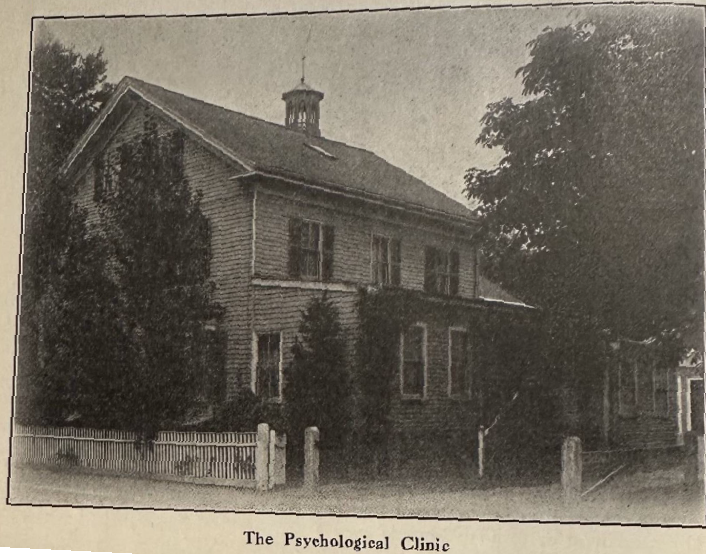
Henry A. Murray, "The Harvard Psychological Clinic," Harvard Alumni Bulletin 38 (1935), 142-49, 142.